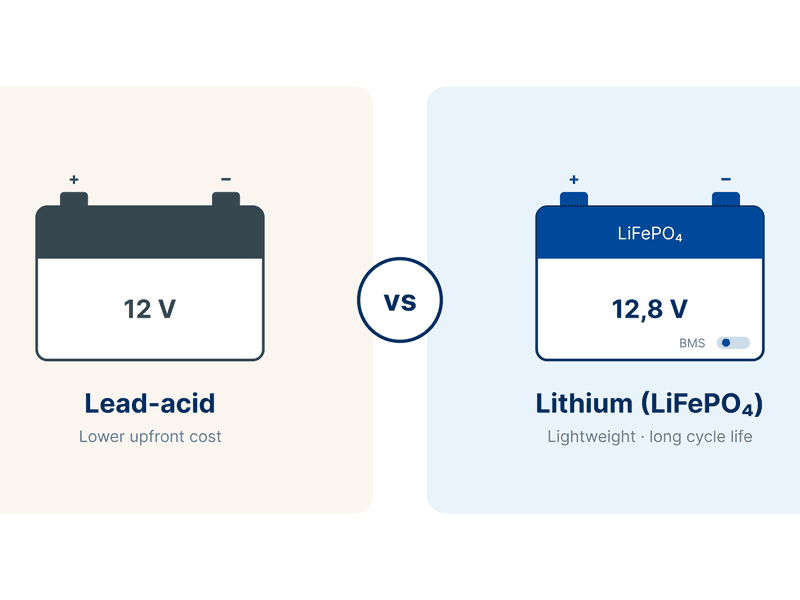
When choosing among the different RV battery types, the principal divisions are: deep cycle vs. starter batteries and lead-acid vs. lithium batteries. Within lead-acid, there are also a number of different types. This article will explain these RV battery types and help you choose which one is best for your build.
RV battery types: starter batteries and deep cycle batteries
Your starter battery, also called a cranking battery or an SLI battery, is the vehicle battery. It's the low-capacity, 12V (in cars and vans) or 24V (in trucks) battery which powers the starter motor when you turn the key in the ignition. It holds enough power to run the starter motor and vehicle electronics, but, as any vehicle owner knows, it’s easy to run the starter battery down. Deeply discharging a starter battery rapidly degrades its electrodes, rendering it unusable. They’re not suitable for powering RV systems.
A deep cycle battery is a lead-acid battery designed to be deeply discharged, which means discharging to or beyond 50% of its total capacity. Usually, leisure batteries and house batteries (batteries powering RV or marine electrical systems) are deep cycle batteries. Traction batteries, designed to power electric vehicles like golf carts and forklifts, are also deep cycle batteries.
To summarise our overview of RV battery types:
- Starter battery/cranking battery/SLI battery: low-capacity lead-acid battery designed to power starter motors at engine ignition. Not suitable for powering RV systems.
- Leisure/house/RV/marine battery: a higher-capacity battery designed to power off-grid electrical systems
- Deep cycle battery: a lead-acid battery designed for regular deep discharging.
- Traction battery: a deep cycle battery designed to power electric vehicles.
- Dual-purpose/semi-traction battery: a lead-acid battery that’s a compromise between a cranking battery and a deep cycle battery. Lacks true deep cycle characteristics.
Lead-acid RV battery types
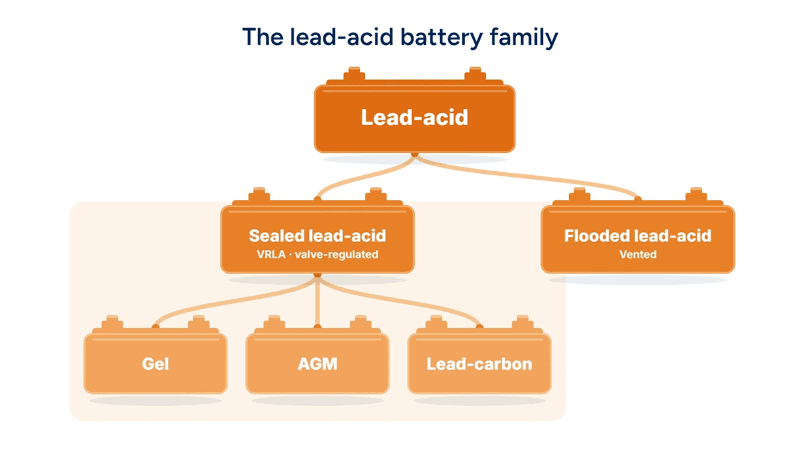
Lead-acid batteries are divided into two families: flooded and sealed (valve-regulated lead-acid or VRLA). Sealed lead-acid batteries are further subdivided into AGM, gel, and lead-carbon batteries.
Flooded lead-acid batteries
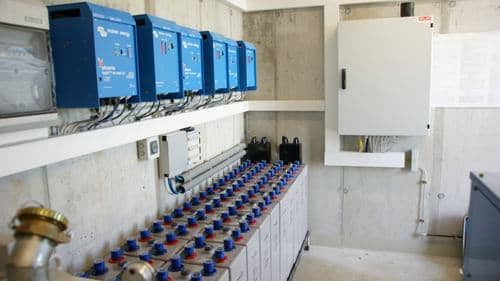
Flooded lead-acid batteries (also called wet cell or vented batteries) are a largely outdated type of RV battery that uses sulphuric acid diluted with water to flood the lead electrodes. These batteries are inexpensive, but inappropriate for RVs for a number of reasons:
- Must be kept upright: because they’re filled with a liquid electrolyte, these batteries must be installed upright and must never be tipped or agitated to prevent the liquid acid from spilling.
- Intolerant to vibration: the lead plates are only lightly physically supported, and sustained vibration damages them, accelerating battery degradation.
- Ventilation: flooded lead-acid batteries release hydrogen gas during charging. Hydrogen is highly flammable, and so the battery compartment must be adequately ventilated.
- Regular maintenance: the level of the liquid electrolyte must be regularly checked and topped up with deionised or distilled water. Additionally, the battery needs periodic overcharging (equalisation) to clean the plates and keep the acid and water mixed to prevent stratification.
The low cost of these batteries has been offset by the drop in price of other, safer, maintenance-free RV battery types.
Sealed lead-acid (VRLA) batteries
Sealed lead-acid batteries recombine gas back into the electrolyte rather than venting it and require no liquid top-ups. There are three RV battery types that fall into this category:
AGM batteries
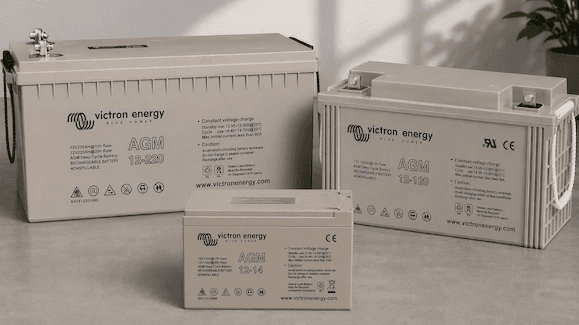
AGM (absorbent glass mat) batteries use electrolyte held in fibreglass mats rather than a free liquid. These batteries don’t vent gas under normal circumstances, and thus don’t need topping up. If overcharged, the battery releases gas through a pressure-relief valve, and this electrolyte is permanently lost.
Pros of AGM batteries:
- Spill-proof, requiring no electrolyte top-ups
- Very little gassing in normal use
- Vibration-resistant
- Can be mounted in most orientations (though not upside-down)
- Low internal resistance, giving high-current delivery; supports high-current appliances like inverters well
- Comparatively fast charge acceptance, allowing for fast recharging
- Cold resistance: can be charged at below-freezing temperatures
- Cheaper than gel, lead-carbon, and lithium
- No battery management system (BMS) required: as with other lead-acid types, AGM batteries function without an external BMS.
Cons of AGM batteries:
- Limited usable capacity: compared to lithium, gel, and lead-carbon, AGM batteries shouldn’t be routinely discharged below 50% as this significantly shortens their lifespan.
- Limited cycle life: whilst better than flooded lead-acid, AGM offers fewer charge cycles than other VRLA variants before needing replacement. AGM Super Cycle batteries perform better than standard AGM in this regard (see below).
- Heat-sensitive: when operating at high voltage towards the end of a charge cycle in hot conditions, all batteries can experience ‘thermal runaway’, a dangerous malfunction which kills the battery. Among VRLA batteries, AGM are slightly more likely to experience thermal runaway if used without a quality battery charger.
- Vulnerable to sulphation: particularly if left partly charged, sulphur can precipitate out of the electrolyte and coat the electrodes in a hard layer in a process called sulphation. This permanently damages the battery and reduces its usable capacity.
Gel batteries
Gel batteries are a type of sealed lead-acid RV battery where the sulphuric acid is emulsified in a gel. As with AGM batteries, gel batteries don’t vent under normal circumstances and require no electrolyte top-ups; they’re thus considered ‘maintenance-free’.
Pros of gel batteries
- Spill-proof, requiring no electrolyte top-ups
- Very little gassing in normal use
- Vibration–resistant
- Can be mounted in most orientations (though not upside-down)
- Longer cycle life: offers more cycles than AGM before falling to 80% of its original capacity and requiring a replacement
- Better usable capacity: tolerates deep discharging better than AGM
- High thermal resistance: lower risk of thermal runaway
- No BMS required: as with other lead-acid types, gel batteries function without an external BMS.
Cons of gel batteries
- Higher internal resistance: lower peak current delivery, not well suited to high-current appliances
- Slow charge acceptance and limited maximum charge current: recharges slowly
- Very sensitive to overvoltage: creates permanent voids in the gel. More sensitive than other lead-acid types.
- Sensitive to cold: more capacity and current lost in the cold than other battery types.
- More expensive than AGM.
- Vulnerable to sulphation: particularly if left partly charged, sulphur can precipitate out of the electrolyte and coat the electrodes in a hard layer in a process called sulphation. This permanently damages the battery and reduces its usable capacity.
Lead-carbon batteries
This might be considered a sub-category within the AGM RV battery type. Lead-carbon batteries have carbon added to the negative lead plate inside the battery. This added carbon slows the buildup of sulphur crystals on the negative plate, which is the main cause of aging in lead-acid batteries. It also improves charge acceptance.
Pros of lead-carbon batteries
- Spill-proof, requiring no electrolyte top-ups
- Very little gassing in normal use
- Vibration-resistant
- Can be mounted in most orientations (though not upside-down)
- Highly resistant to sulphation: copes very well when left partly charged.
- Long cycle life: broadly comparable cycle life (number of cycles before reaching 80% of initial capacity) to gel batteries
- More usable capacity: tolerates regular deep discharging better than AGM and gel.
- Fast charge acceptance: charges more quickly than AGM and gel.
- Low internal resistance: high-current delivery; supports high-current appliances like inverters well.
- Cold resistance: can be charged at below-freezing temperatures
- No BMS required: as with other lead-acid types, lead-carbon batteries function without an external BMS.
Cons of lead-carbon batteries
- More expensive than AGM and gel
Victron Energy lead-acid RV battery types
Victron Energy manufactures AGM, gel, and lead-carbon batteries at 12V and in a range of capacities.
Whilst AGM batteries typically offer the lowest cycle life amongst VRLA batteries, Victron manufactures the AGM super cycle battery is an improved AGM battery which has better deep discharge performance and a longer lifespan than standard AGM.
These are the three types of lead-acid batteries commonly marketed for use as leisure batteries in RVs. We’ve largely compared them with each other as, on most metrics, they don’t compare with the next RV battery types we’ll discuss.
Lithium batteries
Lithium batteries, also called lithium-ion batteries and LiFePO4 batteries, are a newer class of battery. They’re deep cycle batteries by nature, and are mostly sold as leisure or house batteries. Many different lithium battery chemistries exist, but they all use the movement of lithium ions into and out of a layered material to store and release electricity.
Lithium batteries designed as leisure or 'house' batteries are almost always lithium iron phosphate (LiFePO4 or LFP).
Pros of lithium batteries
- Spill-proof, requiring no electrolyte top-ups
- No gassing under any circumstance
- Extremely vibration-resistant
- Can be mounted in most orientations (though not upside-down)
- No sulphation: can be left partially charged without issue
- Very long cycle life: cycle life far exceeds that of all lead-acid battery types
- Superior usable capacity: designed to be regularly discharged to 20% state of charge or lower
- Very fast charge acceptance: charges much more quickly than all lead-acid battery types
- Very low internal resistance: very high-current delivery; supports powerful inverters and appliances better than lead-acid batteries.
- Heat-resistant: doesn’t degrade as much as lead-acid battery types in high heat. LiFePO4 or LFP is very thermally stable compared with other lithium types and with lead-acid chemistries, making it highly resistant to thermal runaway when coupled with the mandatory BMS.
- Lightweight: significantly lighter than all lead-acid chemistries for a given capacity.
Cons of lithium batteries
- More expensive: higher upfront than lead-acid RV battery types.
- Require a BMS: a BMS is mandatory to manage safe charging and discharging.
- Sensitive to cold: lithium batteries can’t be charged below 0°C, and most manufacturers don’t allow charging below 5°C as a safety margin.
Victron Energy lithium batteries
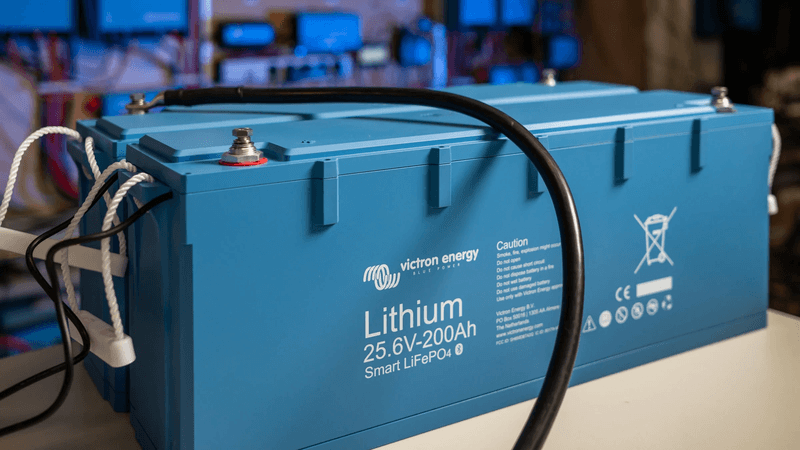
All of Victron’s lithium batteries use the safe, thermally stable LiFePO4 or LFP chemistry.
- Lithium Smart: lithium batteries with built-in Bluetooth monitoring of cell voltage and temperature using the VictronConnect app. An external BMS is required to handle disconnection of the battery in unsafe charging or discharging conditions.
- Lithium SuperPack: an all-in-one lithium battery, perfect as a drop-in replacement for lead-acid, with an integrated BMS meaning no external BMS is required. 12V and 24V models can be connected in parallel to increase capacity. Can only be mounted upright.
- Lithium Battery NG: successor to the Smart range. Compared to Smart batteries, NG batteries are more compact, add a cell voltage instant readout, include a 48V model, are IP65 rated against dust and water jets, and can be parallelled to create banks of up to 385kW in capacity. Requires an NG-series external BMS (not compatible with Smart batteries) to handle safety disconnect.
- Lithium SuperPack NG: successor to the SuperPack range. Incorporates an integrated BMS, an on/off switch, built-in Bluetooth monitoring, integrated heating for charging in the cold, and a smaller format for under-seat installation.
Factors to consider when choosing among RV battery types
Having explored the different types of RV battery, you should now be ready to choose one around which to build your RV electrical system. There are a number of factors which make flooded lead-acid batteries unattractive:
- Not spill-proof: the liquid electrolyte means that, if incorrectly secured, tipping the battery over or excessive vibration on a bumpy road risks spillages of sulphuric acid.
- Frequent gassing: flooded batteries are designed to release flammable hydrogen gas under a variety of circumstances; dangerous in small, poorly ventilated battery compartments with cooking stoves in close proximity.
- Maintenance requirement: mandatory regular level checks and top-ups with distilled water are impractical for life on the road.
When comparing lead-acid batteries with lithium, your choice will depend on a handful of factors.
- Upfront cost and frequency of use: lithium batteries cost more upfront than lead-acid. After about 5 years, when lead-acid batteries need replacing, the initial investment for lithium begins to pay for itself. If you’re using your RV and cycling your batteries more than about 160 days a year, lithium pays for itself sooner as regular use degrades lead-acid more quickly.
- System capacity: small systems where batteries are only subjected to light DC loads like lighting and ventilation are less likely to degrade lead-acid batteries in the long term. If your batteries are unlikely to drop below ~70%, lead-acid may be sufficient.
- Cold climates: if you’ll be charging your batteries in sub-zero temperatures and heating lithium batteries is impractical, lead-acid may be a better choice.
- Fast charging and high discharge rates: for many RV users, fast charging is essential to maintain off-grid independence. Equally, for high-power appliances like 1200W+ inverters, a battery which can provide high discharge currents is essential. Lithium and selected high-current lead-acid batteries are the desired choice in these cases.
- Space and weight: Lithium batteries take up about a third of the space and weigh a third as much as lead-acid batteries for a given usable capacity. For smaller RVs and vans where space and kerb weight are legitimate concerns, lithium is easier to accommodate into the build.
For an at-a-glance summary of the differences between the RV battery types discussed in this article, take a look at our comparison table. For a much more in-depth explanation of the comparison between lead-acid and lithium batteries, take a look at our in-depth guide.
Final Thoughts
Choosing between the different RV battery types comes down to your specific requirement. Having read this article, you might like to look at how lead-acid and lithium batteries stack up in more detail, or more thoroughly explore the different types of lead-acid batteries. A good next step is to correctly size your leisure batteries based on your usage. For a more detailed look at how your leisure batteries will be charged and an illustration of why internal resistance and charge speed may be important, take a look at our article on charging RV batteries.