Beril Berkem • 4 May 2026
How to size a solar system for your RV
Learn more
How to size an RV battery bank
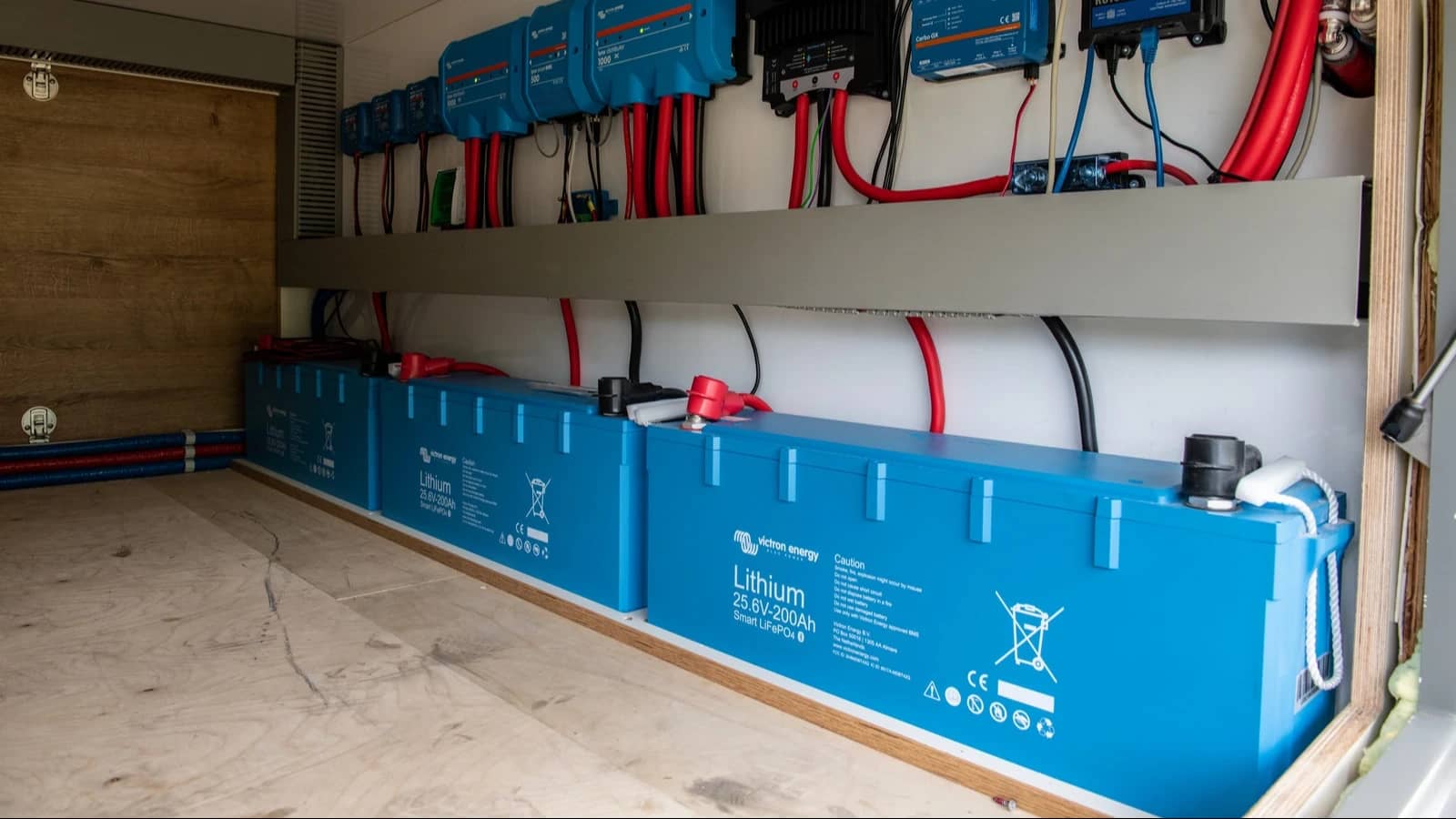
What size battery you install in your travel trailer or RV depends on your daily electricity usage and time you want to spend off-grid. Proper RV battery sizing ensures you have enough stored energy to power your systems without running out of electricity. An RV battery bank is the core of your RV electrical system, powering all your house devices and appliances like lighting, fans, fridges, heaters, and water pumps. When paired with an inverter or inverter/charger, it can also power standard household mains (120/230V) appliances whenever you're not connected to shore power. An undersized battery bank limits your time off-grid, while an oversized system adds unnecessary cost, weight, and space. Choosing the right size gives you the best balance of performance, efficiency, and value.
By the end of this guide, you'll know how to work out your power requirements, estimate your daily energy consumption, and calculate an RV battery size that matches your use and travel style.

Calculating your RV battery size starts with an accurate, realistic estimation of your daily electricity usage. Make a list of all the electrical devices and appliances in your RV, including:
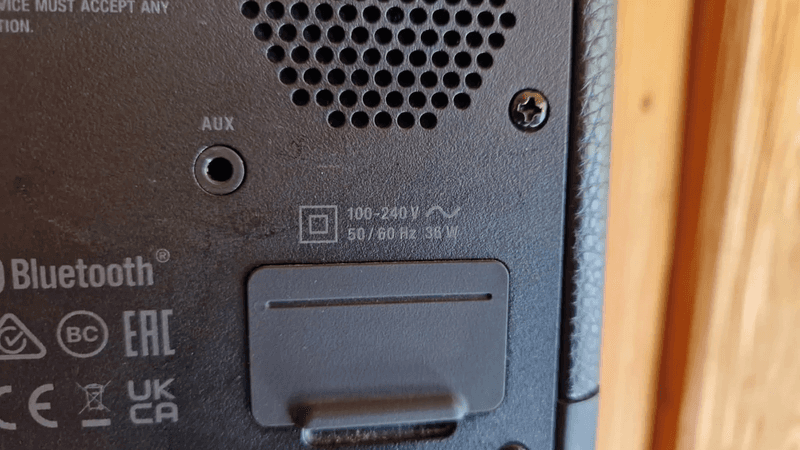
Even wireless devices which you periodically charge, like Bluetooth speakers and drones, must be factored in.
Once you have your list of devices, check the power rating in watts (W). Most appliances have the power rating printed at the rear or underside, and device chargers will display the power rating on the plug. The power rating of AC devices must take into account inverter efficiency, found in the inverter datasheet. Inverter efficiency is a measure of the power that’s lost in the conversion from DC to AC, and effectively increases the power rating of an AC device. To keep things simple, add 15% to the power rating of all AC devices if your inverter capacity is smaller than 1,000W, and add 10% if your inverter capacity is larger than 1,000W.
Once you have the power rating of all your devices in watts, establish the number of hours you’ll use each appliance each day. Note that whilst fridges are plugged in all the time, the compressor only actually runs for about half the time they’re plugged in. We therefore assume that a fridge is only actually drawing power for about 12 hours a day. Some devices are not charged or used every day:
Calculating daily usage for devices not used or charged every day
Daily run time = number of hours running/charging ÷ days between use/charge
For an example device that takes 2 hours to charge but is only charged every 3 days:
Daily run time = 2 ÷ 3
Daily run time = 1.5 hours
Once you have your list of devices, their power rating in watts, and their daily run time in hours, simply multiply these numbers together to arrive at the device’s power usage over time, stated in watt-hours (Wh). Add up all of these watt-hour figures to get your total daily electricity usage.
Example daily electricity usage list
Leisure battery voltage determines the voltage of your electrical system as a whole. Most base RV vehicles’ on-board electronics run on 12V DC electricity, and matching your leisure batteries to this voltage avoids needing to convert between voltages. However, larger base vehicles like trucks might use 24V, and a 24V or 48V system might make sense in other cases:
For more information on choosing between 12V, 24V, and 48V, see section 3.2 (‘Battery Voltage’) in our inverter/charger help-me-choose guide.
Your chosen battery voltage is used to determine the battery size for your RV. Leisure battery rated capacity is quoted in amp-hours (Ah) rather than Wh. We thus need to convert our calculated target rated capacity from Wh to Ah, which we do by dividing the capacity in Wh by the voltage:
Converting from watt-hours to amp-hours based on battery voltage
The next step in calculating RV battery size is to factor in off-grid, no-charge days. This is the number of days you’ll go between battery charges. If you’ll be staying at campsites every other night and recharging your batteries via a shore power connection, your number of off-grid days is only 1. If you’ll be driving every day and charging via a DC-DC charger, we can also treat this as one off-grid day. If you’ll be doing a lot of wild camping (boondocking or dry camping), your solar panels are the primary charging source. How many hours of solar charging will you get each day? Weather and time of year affect this enormously.

When choosing an RV battery for dry camping where solar panels are the primary charging source, we recommend factoring in a minimum of two off-grid days. For long trips, full-time van living, boondocking in areas with frequent bad weather, and winter usage, we recommend factoring in three off-grid days.
We will continue the example above and say that we want to be off-grid for three days:
Calculating required electricity storage capacity for off-grid days
Battery size for boondocking
Boondocking typically requires a larger battery bank than campground camping because you can't rely on shore power. A properly sized battery and solar system gives you the freedom to camp farther off-grid and enjoy your adventures without depending on campground electrical hookups and without having to run the engine to top up via the DC-DC charger.
Off-grid usage is also a major factor when deciding solar panel size; learn how these calculations overlap in our guide on sizing an RV solar system.
Usable capacity is a measure of how much of a battery's rated capacity can actually be used to power your electrical system. No leisure battery should be discharged until it’s completely empty, but usable capacity differs with battery chemistry. Lithium leisure batteries can be regularly discharged to 70-80% of their rated capacity, whilst lead-acid batteries should only be discharged by 50%. As a result, for a target usable capacity, a lead-acid battery bank must be significantly larger than a lithium battery bank with the same rated capacity.
If you’re buying lead-acid batteries, you’ll need a battery bank whose rated capacity is twice your calculated off-grid requirement. If you’re buying lithium, you’ll need a battery bank with a rated capacity of 125% your off-grid requirement.
Calculating required battery bank rated capacity based on battery usable capacity
For a more complete understanding of the differences between battery chemistries, take a look at our guide to upgrading from lead-acid to lithium leisure batteries.
No. Lead-acid and lithium batteries should never be connected together in the same battery bank. Even when using the same battery chemistry, it's best to use batteries of the same brand, model, age, and capacity.
That concludes our process for deciding what size battery you need for your travel trailer or RV. Note that with a higher required usable capacity, you’re likely to need to make a battery bank out of multiple individual batteries. As we mentioned earlier, it’s important that your battery bank is composed of individual batteries of the same model, age, and capacity. These batteries will need to be wired together in parallel in order to add their capacities together; wiring them in series will produce a bank with the same capacity and a higher voltage. A battery management system is a good addition to any battery bank; it balances the individual batteries in a multi-battery bank, whilst also protecting them from overcharging and over-discharging.
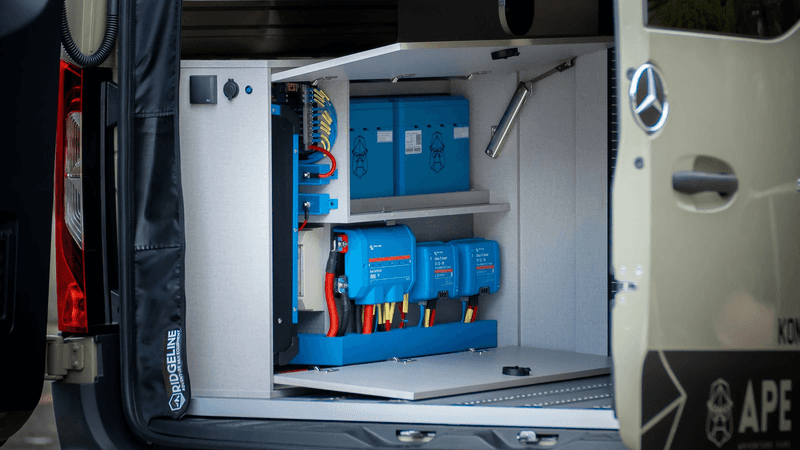
Taking the time to properly size your RV battery bank ensures you’ll have the power you need without overspending or adding too much weight. Make sure that your daily power usage calculation is accurate and not optimistic; if in doubt, round up. The same goes for required off-grid days.
To learn more about leisure batteries and the theory behind RV battery size calculations, take a look at our explainer on how lead-acid batteries work, the different lead-acid battery types, and upgrading from lead-acid to lithium. Our deep-dive on solar system sizing goes into the nuances of off-grid days in more detail, and our overview of the components in an RV electrical system places batteries in a wider context.
Sie benötigen Beratung? Unsere bestens geschulten Fachhändler helfen Ihnen gerne bei kleinen und großen Fragen weiter.
Finden Sie einen Händler in Ihrer Nähe
Sehen Sie sich unsere Support-Ressourcen an oder wenden Sie sich für speziellen Support, Reparaturen oder Garantieanfragen an Ihren Originalhändler.
Support
Lesen Sie mehr über unsere branchenführende 5-Jahres-Standardgarantie und unseren weltweiten Reparaturservice.
Garantie


©Victron Energy 2026